Loop Alcohólico
Crónica desde el South West Chicago
Por Zur
Mayo, 2026, Chicago.
Aquí hay un cuerpo que escribe, y para mí las costumbres avanzan de manera circular y si se visualizan de manera teleológica, es como una especie de espiral que avanza a partir del punto en donde se toca a sí mismo. La semana pasada vi la película “Barbarosa” de 1982 y es una película que ejemplifica esa especie de movimiento en espiral de las costumbres heredadas. Situada en un ir y venir entre la frontera de Texas y México, la película rompe con la dinámica del western de acción y nos presenta el fondo familiar, tradicional y de costumbres que sostiene la figura del bandido fronterizo.
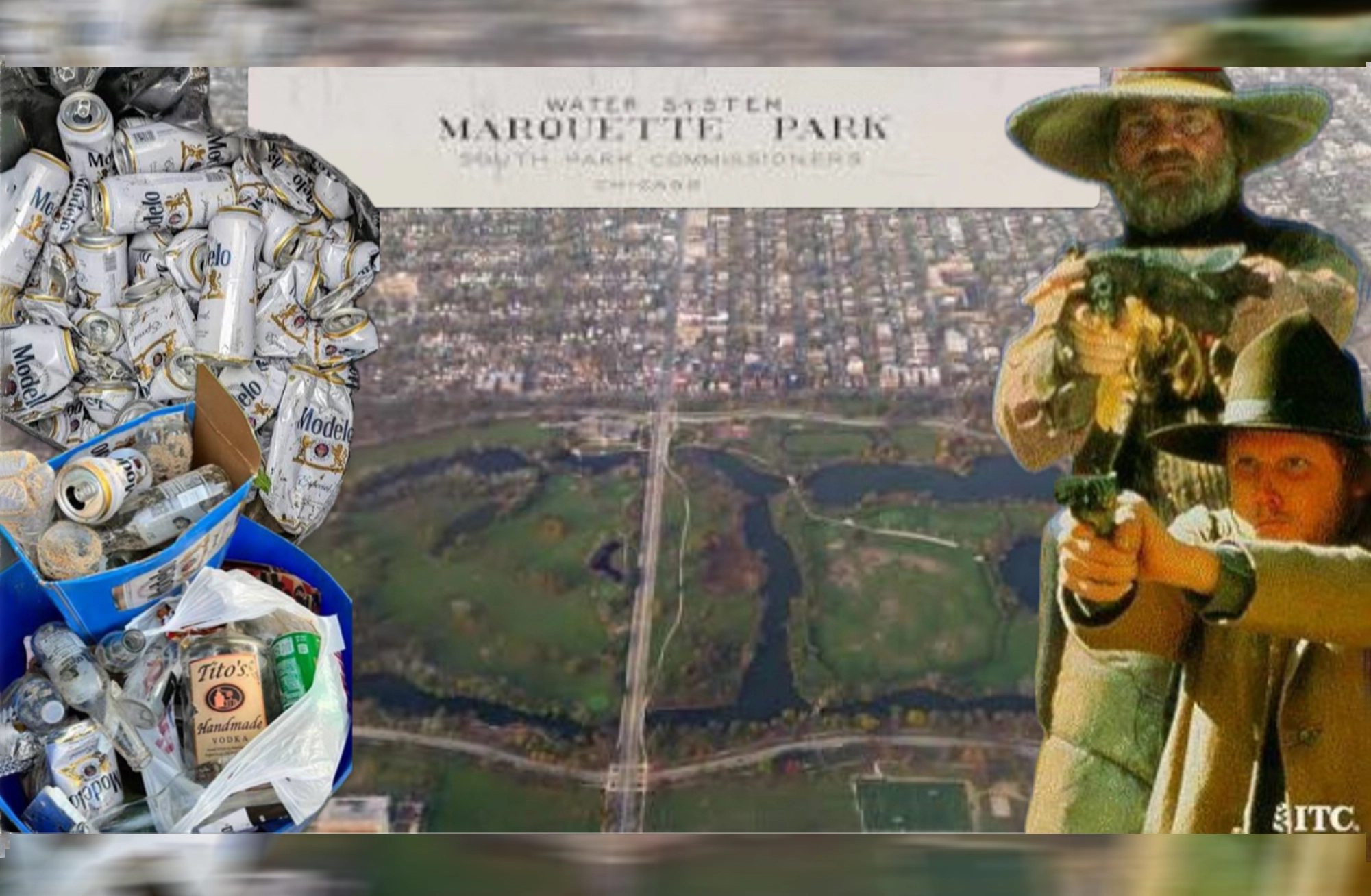
Después de ver cualquier película suelo dar caminatas en Marquette Park que es uno de los parques más grandes de Chicago y que se encuentra en el centro del southwest. A esa hora un grupo de jóvenes ambientalistas, en su mayoría mexicoamericanos, se encontraba realizando una recolección de basura en el parque bajo el motivo del próximo Día de la Tierra. La cantidad de basura recolectada por estos jóvenes era notable y en su mayoría se trataba de latas de cerveza y botellas de tequila vacías, ¿qué narrativa se inscribe en el espacio entre una persona y veinticuatro latas de cerveza vacías tiradas en la mitad del parque?
Me acerqué a uno de estos jóvenes para preguntarle si cada año hacían esta limpieza, me dijo que tratan de hacerla regularmente, cada cuatro o tres meses y que siempre recolectan la misma cantidad y el mismo tipo de basura. Hay una repetición que se presume automática. Ciertamente que en ese espacio entre la persona y su basura abandonada en el parque hay toda una madeja de costumbres, justificaciones o simplemente es valemadrismo, pero incluso ese valemadrismo tendrá sus raíces en costumbres heredadas.
En la trama de la película, el nombre Barbarosa adquiere su densidad sólo en relación con el deseo de venganza de la familia Zavala y la familia adquiere su sentido interno y hasta ritual sólo en relación a vengarse del bandido. Son dos instancias que se retroalimentan a sí mismas para mantener la narrativa general del drama fronterizo. Me dio la impresión de que como fenómeno el código cultural tiene una inercia propia que transmitido de generación en generación se vuelve automático y para mantener su continuidad lo que hace es sostenerse en loop ajustándose a los elementos o motivos del nuevo entorno, pero de fondo es el mismo fenómeno, código y narrativa. Barbarosa muere pero hereda todos sus conocimientos al joven que lo acompaña y así nace un “nuevo bandido” y el deseo de venganza de la familia Zavala se regenera también.
Beber y escuchar corridos abajo de un mezquite es un código cultural que se actualiza en toda la zona fronteriza y tiene una representación cinematográfica de larga data y parece ser que se reproduce en cualquier parte. En esta zona de Marquette Park migrantes mexicanos vienen a beber, disfrutan, dejan sus residuos y se van. No hay una vivencia de los espacios como propios, no hay vinculación con el entorno y eso es una constante en la comunidad migrante de Chicago. De fondo es la misma estructura narrativa desarrollada en los lugares de origen, solo que ahora, al estar lejos del terruño, la añoranza festiva parece justificar una acción que pasa desapercibida en su calamidad pública y nadie la señala por una especie de complicidad cultural tácita.
No quiero racializar el hecho de tirar basura alcohólica en los parques públicos pero sin duda es una costumbre que está activa en su repetición y es justo esa repetición la que la vuelve costumbre, es un loop automático que igual se ve en los parques públicos en cualquier ciudad de méxico y se repite a sí mismo en cualquier parque público de Chicago en donde se articulan comunidades de la diáspora mexicana. Beber debajo de un árbol en medio del parque escuchando corridos me puede generar la emoción de que aun estoy en el rancho, aún y cuando esté en medio de uno de los parques de una de las ciudades más importantes del planeta.
El problema de la basura alcohólica en Marquette Park no puede solucionarse en sus efectos y abarcar las causas del mismo es una tarea casi imposible, a pesar de eso el Dia de la Tierra se celebró bajo la limpieza auspiciada por estos jóvenes y en cierto sentido la narrativa de estos jóvenes ambientalistas depende y se articula en torno a la basura alcohólica que se genera cada cuatro meses y así la herencia cultural avanza en un espiral que se alimenta y se regenera a sí mismo en loop, a lo sísifo.
South West Chicago, 2026.
Contacto: ppmarin@neiu.edu
Foto Collage por Zur.
May, 2026, Chicago.
Here is a body that writes, and for me, customs advance in a circular fashion, and if viewed teleologically, it's like a kind of spiral that moves forward from the point where it touches itself. Last week I saw the film “"Barbarosa" Released in 1982, this film exemplifies the spiraling nature of inherited customs. Set against the backdrop of the back-and-forth between the Texas and Mexico border, the film breaks with the typical action western dynamic and presents the familial, traditional, and customary background that underpins the figure of the border bandit.
After watching any movie, I usually go for walks in Marquette Park which is one of the largest parks in Chicago and is located in the center of southwest. At that time, a group of young environmentalists, mostly Mexican-American, was carrying out a garbage collection in the park for the reason of the upcoming Day of the Earth. The amount of trash collected by these young people was remarkable, and it was mostly empty beer cans and tequila bottles. What narrative is inscribed in the space between a person and twenty-four empty beer cans lying in the middle of the park?
I approached one of these young men to ask if they did this cleanup every year. He told me that they try to do it regularly, every three or four months, and that they always collect the same amount and the same type of trash.There's a repetition that seems automatic. Certainly, in that space between the person and their trash left in the park, there's a whole tangle of customs, justifications, or simply valemadrismo, but even that valemadrismo will have its roots in inherited customs.
In the plot of the film, the name Barbarossa It acquires its density only in relation to the Zavala family's desire for revenge. And the family acquires its internal meaning, even its ritualistic aspect, only in relation to avenging itself against the bandit. These are two instances that feed back into each other to maintain the overall narrative of the border drama. I got the impression that, as a phenomenon, the cultural code has its own inertia, which, transmitted from generation to generation, becomes automatic, and to maintain its continuity, it relies on...loop adjusting to the elements or motifs of the new environment, but at its core it is the same phenomenon, code and narrative. Barbarosa dies but inherits all his knowledge to the young man who accompanies him, and thus a "new bandit" is born, along with the Zavala family's desire for revenge It also regenerates.
Drinking and listening to corridos under a mesquite tree is a cultural code that is constantly being updated throughout the border region and has a long-standing cinematic representation, seemingly reproduced everywhere. In this area of Marquette Park mexicans migrants come to drink, enjoy and then they leave their trash and go. There's no sense of ownership of the spaces, no connection to the environment, and that's a constant in Chicago's migrant community.The underlying narrative structure is the same as that developed in the places of origin, only now, being far from home, the festive longing seems to justify an action that goes unnoticed in its public calamity and no one points it out due to a kind of tacit cultural complicity.
I don't want to racialize the act of littering with alcohol in public parks but it is an undoubtedly habit that persists through repetition, and it is precisely this repetition that makes it a custom. Loop this automatic scene, which you see in public parks in any city in Mexico, is repeated in any public park in Chicago where Mexican diaspora communities gather. Drinking under a tree in the middle of the park while listening to corridos can evoke the feeling that I'm still back in my rancho, even though I'm in the middle of one of the parks in one of the most important cities on the planet.
The problem of alcoholic waste in Marquette Park Its effects cannot be resolved, and addressing its causes is a nearly impossible task; despite this, Earth Day It was celebrated under the cleanup sponsored by these young people, and in a certain sense the narrative of these young environmentalists depends on and is articulated around the alcoholic waste that is generated every four months, and so the cultural heritage advances in a spiral that feeds and regenerates itself as a loop, like Sisyphus myth.
South West Chicago, 2026.
Contact: ppmarin@neiu.edu
Photo collage by Zur.